
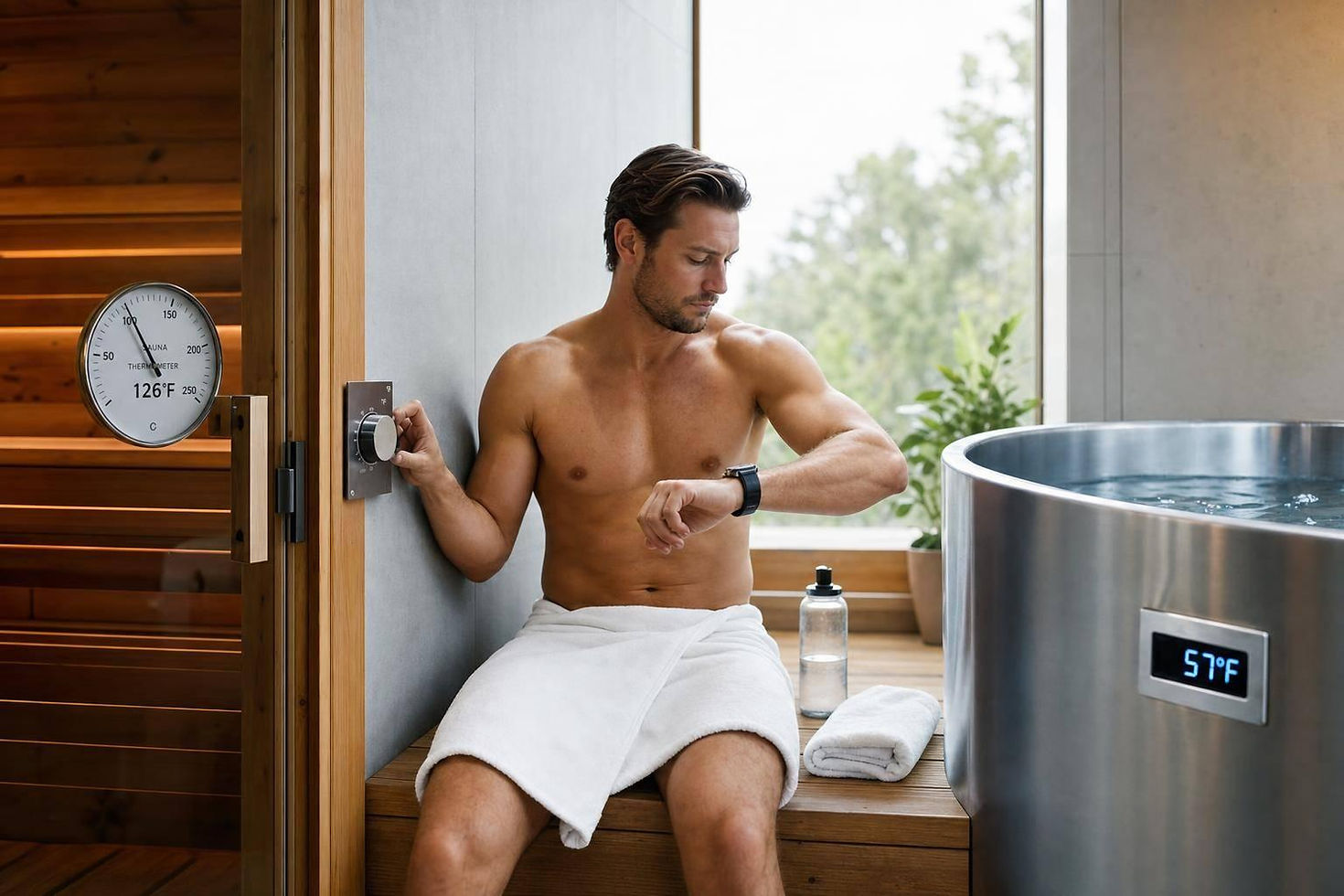
Customizing Temps for Recovery Goals

Most people do not need extreme heat or ice-cold water to recover well. If I want a simple starting point, I’d use an infrared sauna at 122°F to 130°F for 5 to 10 minutes and a cold plunge at 55°F to 59°F for 1 to 2 minutes.
Here’s the short version:
For sore muscles: I’d start with moderate cold, not the coldest water.
For stress relief: I’d keep sauna heat comfortable and use a short, gentle cool-down.
For fast turnaround after training: I’d keep both heat and cold brief and controlled.
For beginners: I’d change one thing at a time - either temperature, time, or rounds.
For safety: I’d stop right away for dizziness, chest pain, confusion, faintness, or breathing that does not settle.
A few numbers stand out:
Infrared saunas often run 110°F to 135°F
Cold plunges often start at 50°F to 59°F
One beginner contrast round can be as short as 10 to 15 minutes of heat plus 30 to 90 seconds of cold
Guidance in the article notes only 1 to 2 extra minutes every 4 to 5 visits for sauna time
The main idea is simple: match the temperature to the goal, not to ego. I’d start mild, track how I feel the next day, and only then make small changes.
How hot to cold contrast hydrotherapy resets your body
sbb-itb-10d9b3e
Quick Comparison
Goal | Sauna starting point | Cold starting point | My simple rule |
Post-workout soreness | Low to moderate heat | 50°F to 59°F | Skip extreme cold |
Fast recovery | Short heat phase | Short cold phase | End while I still feel steady |
Relaxation | 122°F to 130°F | Gentle, brief cooling | Focus on calm breathing |
Heat tolerance | Build in small steps | Optional | Change one variable only |
Beginner use | Low heat, short time | 55°F to 59°F for 1 to 2 min | Stop after one round if unsure |
If I keep those ranges and stop signs in mind, I can build a session that fits my goal without overdoing it. To see how these sessions impact your timeline, check out this recovery speed calculator.
How to Set Your Infrared Sauna Temperature
Set your infrared sauna based on what your body can handle right now, not whatever number sits at the top of the control panel. Lower heat tends to work better for relaxation. If you're trying to build heat tolerance, go up in small steps. Research uses different temperatures, session lengths, and study groups, so there isn't one perfect setting for everyone. The main thing is simple: pay attention to how you feel during the session.
Start Low, Then Adjust by Comfort
If you're new to infrared saunas, start on the lower end: 122°F to 130°F for 5 to 10 minutes. That range is also a good fit if you just want to unwind.
After you've done a few sessions there and felt fine, you can move into a moderate range of 131°F to 135°F for 10 to 15 minutes.
Higher settings, around 136°F to 140°F, make more sense for people who already know they handle heat well. Even then, start with 10 to 15 minutes and only work up to 15 to 30 minutes if your body handles it well. Stanford Lifestyle Medicine suggests adding only 1 to 2 minutes every 4 to 5 visits, which shows how slow that build should be.
If you feel dizzy, nauseated, weak, or notice chest discomfort, get out right away. Those aren't signs to tough it out. They're signs to stop.
Infrared Sauna Temperature Comparison Table
Think of these ranges as starting points, not medical advice. Use your sauna maker's instructions, and check with a clinician if heat affects any health condition you have.
Temperature range | Suggested user profile | Starting duration | Stop if… |
122°F–130°F | First-time users, relaxation-focused, or acclimating to heat | 5–10 minutes | Dizziness, nausea, weakness, headache, or unusual discomfort |
131°F–135°F | Users who've comfortably tolerated lower settings | 10–15 minutes | Breathing feels difficult, your heart rate feels too high, or any symptoms develop |
136°F–140°F | Experienced users with established heat tolerance | 10–15 minutes initially; build toward 15–30 minutes only as tolerated | Light-headedness, confusion, chest discomfort, palpitations, or persistent nausea |
Once you've dialed in your sauna setting, move on to saunas and cold plunges for recovery. If recovery is the goal, set your plunge temperature after you finish the sauna.
How to Adjust Your Cold Plunge Temperature
After the sauna, set the plunge based on sauna and cold plunge protocols designed for your goal, not some test of grit.
Whether you cold plunge or sauna first, your best temperature depends on three things: your tolerance, your recovery goal, and how long you plan to stay in the water. For many recovery sessions, 50°F to 59°F is a practical starting range.
Start with Moderate Cold Before Going Colder
If you're new to cold plunging, or you just don't know how your body will react, start around 55°F to 59°F for 1 to 2 minutes. Some protocols in the 50°F to 59°F range use 10 to 15 minutes, but that's for people with more experience, not a beginner target. Cleveland Clinic also advises against going below 40°F and says to build your exposure time little by little.
Get in slowly. Keep your head and neck above the water. Then focus on slow exhalations. In the first few minutes, cold shock can cause rapid breathing, so give yourself a moment and wait for your breathing to settle before you decide to stay in. If your breathing stays out of control, or you feel dizzy, faint, confused, have chest pain, or feel numb in a way that makes movement unsafe, get out right away.
For muscle soreness, colder water doesn't seem to beat moderate cold in any clear way. A review summarized by the American Academy of Family Physicians found that moderate cold - 50°F to 59°F - and severe cold - 41°F to 48°F - both outperformed passive recovery for soreness, with no clear edge for the colder range. Put simply, you don't need to go ice-bath cold to get the effect. That's why moderate cold is the best default starting point.
Use the ranges below as a starting framework, not a medical prescription. Adjust based on how your body responds, and change only one variable at a time: temperature or duration.
Cold Plunge Temperature Comparison Table
Experience level | Approximate water temperature | Suggested duration | Primary adjustment variable | Stop conditions |
Beginner | 55°F–59°F (13°C–15°C) | 1–2 minutes | Increase duration gradually before lowering temperature | Uncontrolled breathing, dizziness, faintness, chest discomfort, confusion, or unsafe movement |
Moderate | 50°F–55°F (10°C–13°C) | 3–10 minutes | Adjust duration in small steps; maintain calm breathing throughout | Breathing doesn't settle, dizziness, faintness, loss of coordination, confusion, or numbness that interferes with safe movement |
Advanced | ~41°F–50°F (5°C–10°C) | Brief, structured exposure only | Temperature is the last variable to lower; use a reliable exit plan | Any warning symptom - do not push through cold shock or movement-impairing numbness |
How to Build a Contrast Therapy Session Around Your Goal
Start with one clear goal: post-workout recovery methods, relaxation, or adaptation. Then build the session around that goal.
The smart move is to use the least intense setup that still fits what you're trying to do. For beginners, a common starting point is 10–15 minutes in the sauna, followed by 30–90 seconds in 50–60°F water. Repeat it only once, and only if the first round feels calm and under control. Think of that as one repeatable round. Then pause and assess before doing more.
A simple flow looks like this:
Set the sauna to a temperature you can tolerate
Do a short heat phase
Step out and cool briefly at room temperature
Focus until your breathing settles
Enter the plunge conservatively
Dry off, then sit or stand safely
Wait until your breathing and comfort return to normal before deciding whether to repeat
If you're unsure, stop after one round. That's the safest call for beginners. If you've done this before, a second round can make sense only when the first felt controlled and symptom-free.
Change One Variable at a Time
Let's say you finished one round at 135°F for 10 minutes in the sauna and 55°F for 45 seconds in the plunge. In your next session, you might extend the sauna to 12 minutes while keeping everything else the same. Or you might lower the plunge to 52°F while leaving both durations alone.
What you shouldn't do is change everything at once. Don't lengthen the sauna, drop the water temperature, and add another round in the same session. If something goes well - or goes sideways - you won't know what caused it.
Track a few basics after each session: your goal, sauna temp, plunge temp, number of rounds, breathing, and how you feel the next day. Give yourself one or two well-tolerated sessions before changing anything else. If recovery gets worse or symptoms show up, go back to the last setting that felt okay. And before you turn up the intensity or add rounds, stick to the safety limits below.
Match Session Length to Your Plan
Once your round structure is set, match it to the time you booked. Conscious Body Recovery's 25-, 55-, and 85-minute sessions include both an infrared sauna and cold plunge.
A 25-minute session can work well for one conservative heat-cold cycle, with prep and rest time built in. A 55-minute session can support two moderate rounds with longer rests between them. An 85-minute session is better for a slower, steady routine with plenty of recovery time, not for automatically stacking more intense rounds.
Booking more time doesn't mean staying in the heat or cold the whole time. Use that extra time for hydration, changing, and paying attention to how your body responds.
Safety Limits and How to Apply Them
Once you’ve set your starting temperature, put your safety rules in place before you turn up the intensity. The main idea is simple: stop at the first warning sign. Recovery only counts if you stay within what your body can handle.
When to Stop or Get Medical Clearance
Get medical clearance before starting contrast therapy if you are pregnant, have heart or cardiovascular conditions, have trouble tolerating heat or cold, or take certain medications. Everyone should avoid alcohol before and during sessions to help prevent dehydration and poor temperature control.
Conclusion: Pick a Goal, Start Moderate, Adjust Safely
With those limits in place, use moderate settings as your baseline. Pick one goal, start at the lower end of the right range, and change one variable at a time based on how your body responds.
FAQs
How often should I do contrast therapy each week?
For the best results, aim for 2 to 4 sessions per week.
If your goal is general wellness, 1 to 2 sessions per week is often enough. For athletic recovery or help with a chronic condition, 2 to 3 sessions per week tends to work better.
The big thing is consistency. A steady routine usually does more for long-term results than doing a lot all at once.
Conscious Body Recovery offers private 25-, 55-, or 85-minute sessions, along with unlimited memberships that make it easier to stick with a regular schedule.
Should I do sauna or cold first for my goal?
For most contrast therapy protocols, start with heat. Spend 10 to 15 minutes in the sauna to loosen tight muscles and get blood moving before you switch to cold.
Then move into cold to help drive the vascular pump effect. For the last phase, end with cold if you want more alertness and less inflammation, or finish with heat if your goal is relaxation and sleep.
How do I know when to increase time or temperature?
Increase time or temperature only when your body seems ready. Good signs include better heat or cold tolerance, steady energy, consistent sleep, and a fast return to baseline after each session.
Make small, gradual changes and change just one thing at a time. For example, add 30 seconds or make a slight temperature adjustment. If you feel discomfort, start shivering, or notice a racing heartbeat, pause and stick with your current settings.


Comments